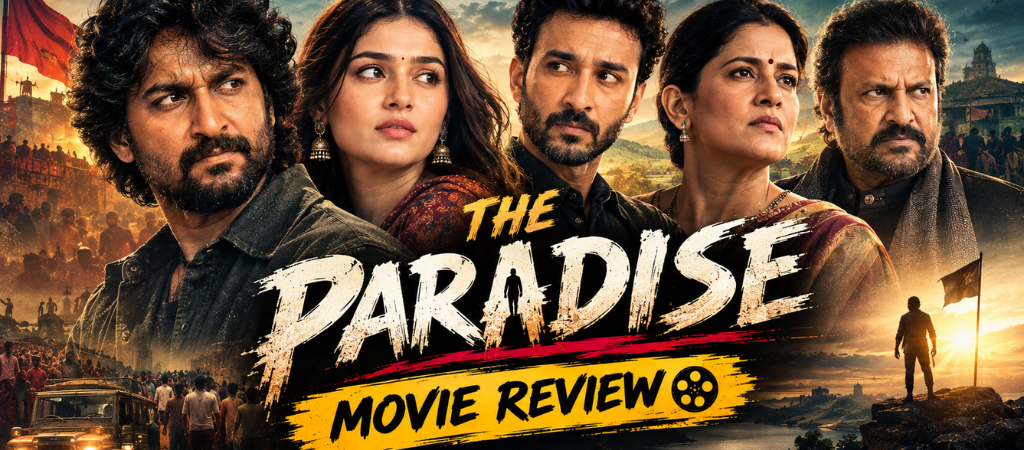
The Paradise Movie Review: Nani returns to a darker and more intense world with The Paradise, an action drama directed by Srikanth Odela. The film brings together Nani, Mohan Babu, Kayadu Lohar, Sonali Kulkarni and Raghav Juyal in important roles. Set against the backdrop of 1980s Secunderabad, the movie explores oppression, identity, dignity, rebellion and the struggle of a marginalised community.
The film reunites Nani and Srikanth Odela after their earlier collaboration Dasara. This time, however, the filmmaker attempts to build a much larger world filled with action, violence, social conflict and emotional drama.
The Paradise was released in theatres on September 24, 2026, and has a runtime of around 2 hours and 45 minutes.
But does the film successfully turn its ambitious idea into an engaging cinematic experience? Let’s take a closer look.
The Paradise Movie Details
| Category | Details |
| Movie | The Paradise |
| Lead Actor | Nani |
| Director | Srikanth Odela |
| Genre | Action, Drama, Adventure |
| Release Date | September 24, 2026 |
| Language | Telugu |
| Runtime | Around 2 hours 45 minutes |
| Producer | Sudhakar Cherukuri |
| Music | Anirudh Ravichander |
| Cinematography | C. H. Sai |
| Editor | Navin Nooli |
| Main Cast | Nani, Mohan Babu, Kayadu Lohar, Sonali Kulkarni, Raghav Juyal |
The movie is built around a serious social conflict while using the presentation style of a large-scale action film. Its setting, characters and visual design are among the major elements that attracted attention before release.
The Paradise Story
The story takes place in 1980s Secunderabad and focuses on the Savari community, a marginalised group struggling for identity, dignity and recognition.
At the centre of the story is Jadal, played by Nani. He is a man shaped by the circumstances around him and carries a complicated relationship with the society in which he lives.
The community exists under the influence of Shikanja Malik, played by Mohan Babu. Malik represents the powerful structure controlling the lives of the people around him.
Jadal’s personal journey eventually becomes connected with the larger struggle of his community. What initially appears to be an individual conflict gradually develops into a fight involving dignity, identity and resistance.
The basic premise gives the movie plenty of material to explore.
It combines:
- Social inequality
- Community identity
- Family relationships
- Power and oppression
- Rebellion
- Revenge
- Political and social recognition
- Personal sacrifice
The film therefore attempts to be more than a conventional action entertainer. It wants its action to carry a larger social meaning.
What Works in The Paradise?
One of the most interesting aspects of The Paradise is its world-building.
The filmmakers have created a gritty environment that gives the movie a distinct visual identity. The setting does not simply exist in the background; it becomes an important part of the story.
The movie also benefits from its central character.
Nani as Jadal
Nani takes a considerably more intense approach to his character in The Paradise.
Jadal is not presented as a typical polished commercial hero. The character belongs to a harsh environment, and Nani’s appearance and body language reflect that world.
His performance is particularly effective when the character has to communicate anger, pain or determination without relying entirely on dialogue.
Several early reviews have also highlighted Nani’s physical transformation and committed performance as one of the film’s notable strengths.
His screen presence helps hold the movie together even when the screenplay becomes uneven.
Mohan Babu’s Character
Mohan Babu plays Shikanja Malik, a powerful figure whose influence creates much of the conflict.
The character provides the film with a strong opposing force and helps establish the power imbalance at the heart of the story.
His presence gives the confrontation with Jadal additional weight.
Raghav Juyal Brings Another Dimension
Raghav Juyal appears as Vikram, a character connected to the dominant power structure.
His role provides a different energy compared with the more serious central conflict. However, the way his character develops may not satisfy every viewer because some supporting characters receive less emotional depth than the premise initially suggests.
The Direction
Srikanth Odela attempts something considerably bigger than a straightforward action film.
The director uses a combination of:
- Period setting
- Social conflict
- Large-scale action
- Emotional drama
- Character conflicts
- Symbolism
- Violent confrontations
The ambition is visible throughout the film.
The challenge is that these different elements do not always come together smoothly.
The movie sometimes feels as though it is moving between several different storytelling modes. A serious social issue may be followed by a large action sequence, which can then lead into another character-based scene.
This creates an uneven rhythm.
The first half establishes the world and characters with considerable curiosity, while the later portions have been described by multiple reviewers as more rushed, fragmented or uneven.
Screenplay and Storytelling
The biggest discussion point surrounding The Paradise is its screenplay.
The basic story idea is interesting because it connects a personal struggle with the larger question of community identity.
However, the film sometimes gives more attention to scale and violence than to developing its characters and emotional situations.
This becomes noticeable particularly when the story starts moving toward its larger conflicts.
A stronger emotional connection between the characters could have made the major moments more impactful.
The movie has several potentially powerful ideas, but not all of them receive enough space to develop naturally.
Does the Story Feel Different?
The film certainly has its own visual world and social setting.
However, some of its larger themes may feel familiar to viewers who regularly watch Indian action dramas involving:
- An oppressed community
- A powerful local authority
- A rebellious protagonist
- Revenge
- Social injustice
- Violent resistance
This familiarity has also been pointed out in early critical reactions.
The film’s presentation tries to give these elements a fresh identity, but the underlying structure may remind viewers of other recent action dramas.
Action Sequences
Action is one of the major attractions of The Paradise.
The movie does not hold back when portraying violence. The fights are designed to make Jadal appear physically powerful and emotionally dangerous.
The action also contributes to the film’s darker atmosphere.
For viewers who enjoy intense action dramas, these sequences may be among the most appealing parts of the movie.
However, the amount of violence can also become excessive.
When action continues for too long without enough emotional or narrative development, its impact can decrease. Some early reviews have specifically pointed to the extended violence and uneven pacing as weaknesses.
So, the action is visually important, but its effectiveness depends heavily on whether the viewer connects with the story behind it.
Music and Background Score
Music is another important part of The Paradise.
The film features music by Anirudh Ravichander, whose background scores are often an important part of the overall impact of action-oriented cinema.
Here, the music works alongside the film’s darker visual style and helps create intensity during important sequences.
The background score is particularly useful in establishing the atmosphere of the film.
However, music cannot completely solve problems related to screenplay or character development. When a scene itself lacks emotional depth, even a strong score has limitations.
Cinematography and Production Design
Visually, The Paradise is one of the more ambitious elements of the film.
The 1980s setting provides an opportunity for the production team to create a distinctive world, and the movie makes considerable use of its locations, costumes, production design and lighting.
The environment feels rough and lived-in rather than polished.
This works well with the story because the visual presentation reflects the difficult circumstances experienced by the characters.
The cinematography also helps the action sequences feel larger and more dramatic.
For viewers who enjoy visually ambitious Indian action cinema, the film has plenty to offer in this department.
Supporting Cast
The movie has a sizeable supporting cast that includes:
- Sonali Kulkarni
- Kayadu Lohar
- Raghav Juyal
- Mohan Babu
- Sampoornesh Babu
- Tanikella Bharani
- Eshwari Rao
Sonali Kulkarni plays Sammakka, Jadal’s mother. Her character is particularly important because the film’s emotional foundation is connected not only to Jadal’s individual journey but also to the larger community and family relationships.
The supporting performances help build the world, although some characters could have benefited from more development.
The Emotional Side of The Paradise
The movie wants the audience to understand that Jadal’s fight is not simply about revenge.
It is connected with:
- His family
- His community
- His identity
- His past
- His dignity
- His relationship with the existing power structure
This is where the film has genuine potential.
However, the emotional impact varies from scene to scene.
At certain points, the film creates sympathy and curiosity about the characters. At other moments, the focus shifts heavily toward action, making the emotional side feel less developed.
This uneven balance is one reason the film may work differently for different viewers.
The Paradise: First Half vs Second Half
| Aspect | First Half | Second Half |
| Story | Establishes the world and conflict | Moves toward the larger confrontation |
| Nani | Strong screen presence | Continues to carry the film |
| Action | Builds gradually | Becomes more prominent |
| Emotional depth | More room for character setup | Sometimes feels rushed |
| Pacing | Generally engaging | More uneven |
| Overall impact | Creates curiosity | Less consistent |
The first half does a better job of making the audience curious about the world and Jadal’s journey.
The second half increases the scale but sometimes sacrifices narrative clarity and emotional development.
The Paradise Movie Review: Strengths and Weaknesses
What Works
- Nani delivers a committed performance.
- The film has an ambitious premise.
- The 1980s setting gives it a distinctive atmosphere.
- The production design adds scale to the world.
- The action sequences are intense.
- The background score supports the film’s darker tone.
- The central conflict has social relevance.
- The film creates a strong visual identity.
What Could Have Been Better
- The screenplay feels uneven in places.
- Some supporting characters needed more development.
- The emotional portions could have been stronger.
- The second half loses some of the momentum created earlier.
- The violence can feel excessive.
- Some story elements may feel familiar to regular viewers of action dramas.
- Several ambitious ideas compete for attention instead of developing naturally.
Is The Paradise Worth Watching?
Whether The Paradise works for you will depend largely on what you expect from the movie.
If you enjoy Nani’s performances, intense action, dark period settings and socially driven stories, there are several elements here that may interest you.
If you prefer films with a tightly structured screenplay, balanced pacing and deeper character development, some portions may feel less satisfying.
The movie clearly attempts to deliver a large cinematic experience rather than a simple character drama.
Its ambition is visible.
At the same time, ambition alone does not guarantee emotional impact. The film’s strongest moments come when its characters and social themes work together. Its weaker moments appear when spectacle becomes more important than storytelling.
Final Verdict
The Paradise is an ambitious action drama with a strong central performance from Nani and an impressive visual world.
The film has an interesting premise and attempts to explore serious themes surrounding identity, dignity and oppression. Its production design, action and atmosphere give it a large-scale cinematic feel.
However, the screenplay does not always maintain the same level of strength. The story can become fragmented, and the emotional development of some characters is not as deep as the premise promises.
Nani remains one of the film’s biggest strengths, while the action and technical presentation provide plenty of moments for fans of intense commercial cinema.
Overall, The Paradise is a film with strong ideas, ambitious presentation and an intense lead performance, but its uneven storytelling prevents every part of that ambition from landing with the same impact.
The Paradise Movie Review – Rating
Our overall rating: 2.5/5
| Category | Assessment |
| Story | ★★★☆☆ |
| Screenplay | ★★½☆☆ |
| Nani’s Performance | ★★★★☆ |
| Supporting Cast | ★★★☆☆ |
| Direction | ★★½☆☆ |
| Action | ★★★½☆ |
| Music & Background Score | ★★★½☆ |
| Cinematography | ★★★½☆ |
| Production Design | ★★★★☆ |
| Emotional Impact | ★★½☆☆ |
| Overall | ★★½☆☆ |
Frequently Asked Questions About The Paradise
Who is the lead actor in The Paradise?
Nani plays the central character Jadal in The Paradise. The film presents him in a much darker and more intense action-oriented role.
Who directed The Paradise?
The Paradise is directed by Srikanth Odela. It marks his second collaboration with Nani after Dasara.
What is The Paradise about?
The film follows Jadal and his community against a backdrop of social oppression, identity struggles and the fight for dignity and recognition. The story is set in 1980s Secunderabad.
Also Check: Love Lottery Movie Review: Story, Cast, and What to Expect
The Paradise Movie Review: Final Thoughts
The biggest strength of The Paradise is its ambition.
The movie wants to combine social themes, powerful characters, action, emotion and a large-scale visual presentation. At its best, it succeeds in creating a distinctive world and giving Nani a character that demands intensity.
The film is less successful when its many ideas compete with one another.
For some viewers, the action, atmosphere and performances may be enough to make the experience worthwhile. Others may find the uneven screenplay and excessive violence distracting.
In the end, The Paradise is not a straightforward action entertainer. It is an attempt to tell a story about identity, power and resistance through the language of large-scale commercial cinema.
That combination makes the film interesting to discuss, even where its execution does not consistently reach the level of its ambition.