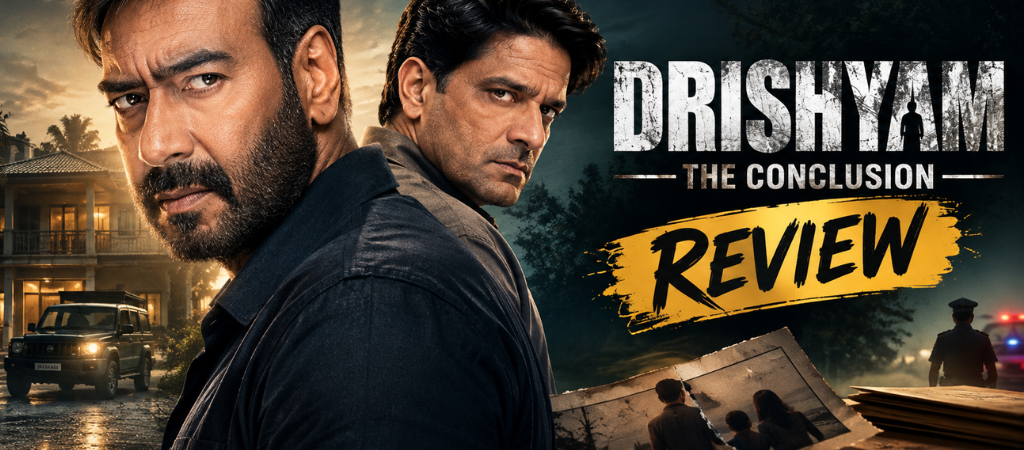
Drishyam: The Conclusion brings Vijay Salgaonkar back for another tense chapter in one of Hindi cinema’s most popular crime-thriller franchises. Starring Ajay Devgn, Tabu, Shriya Saran and Jaideep Ahlawat, the film continues the story of a family trying to protect itself from the consequences of a crime buried in its past.
Released in theatres on October 2, 2026, the Hindi-language thriller is directed by Abhishek Pathak. With a story built around secrets, police investigations, family relationships and the battle between suspicion and proof, the movie faces an important challenge: delivering a satisfying conclusion to a franchise known for its clever twists.
The film has received a strong response from many viewers, particularly for its performances and suspense. However, some reactions also raise questions about predictability and whether every development is equally convincing.
In this Drishyam: The Conclusion review, we look at the story, acting, direction, screenplay, suspense, strengths, weaknesses and overall viewing experience to help you decide whether the film deserves a place on your watchlist.
Drishyam: The Conclusion Movie Details
| Movie Information | Details |
| Movie Title | Drishyam: The Conclusion |
| Release Date | October 2, 2026 |
| Language | Hindi |
| Genre | Crime, Drama, Mystery, Thriller |
| Director | Abhishek Pathak |
| Lead Actor | Ajay Devgn |
| Main Cast | Tabu, Shriya Saran, Ishita Dutta, Jaideep Ahlawat, Prakash Raj |
| Runtime | Approximately 2 hours 50 minutes, according to the theatrical listing |
| Production Studios | Panorama Studios, Star Studio18 |
| Franchise | Drishyam |
| Certification | UA 16+ listed for the Indian theatrical release |
The film continues the Hindi adaptation of the Drishyam franchise, bringing back familiar characters while introducing a new challenge for Vijay Salgaonkar and his family.
What Is Drishyam: The Conclusion About?
The story follows Vijay Salgaonkar and his family, who have spent years trying to move forward while carrying the burden of a crime from their past. Although they want to live a peaceful life, the threat of their secret being uncovered continues to affect them.
Vijay is not a typical thriller protagonist. He is an ordinary man who relies on careful planning, patience and his understanding of people to protect his loved ones. His ability to think several steps ahead has always been central to the appeal of the franchise.
However, the situation becomes more complicated when a determined Crime Branch officer, Rajeev Singh Tomar, enters the picture. His investigation threatens to reopen old questions and challenge the family’s version of events.
At the same time, Meera Deshmukh remains emotionally connected to the case. Her personal loss makes the investigation more than a professional responsibility, adding another layer of conflict to the story.
The movie builds its central tension around several questions:
- Can Vijay continue to protect his family?
- Will the investigators find evidence that changes the case?
- How much longer can the family live with its past?
- Can the truth be established when suspicion and evidence point in different directions?
Rather than depending only on action, the film uses conversations, observation, investigation and psychological pressure to move the narrative forward.
Does the Story Work?
The strongest part of the premise is the continuing conflict between Vijay’s intelligence and the determination of those trying to uncover the truth. The central character knows how difficult it can be to prove what really happened, and that creates opportunities for tense exchanges.
For returning fans, the family history also gives the story emotional weight. The characters are not starting from zero; their earlier choices influence their present circumstances.
The challenge is that audiences familiar with the first two films already understand Vijay’s methods. As a result, the third instalment must create fresh uncertainty rather than simply repeating the same pattern.
That balance between familiarity and surprise is one of the most important factors when judging the film.
Ajay Devgn’s Performance as Vijay Salgaonkar
Ajay Devgn remains the central attraction of Drishyam: The Conclusion. His portrayal of Vijay depends on restraint rather than constant emotional display.
Vijay is a character who often communicates through silence, facial expressions and carefully chosen words. He rarely needs to raise his voice to make a scene feel tense. Devgn understands this quality and uses it to maintain the character’s controlled personality.
One of the interesting aspects of the performance is the contrast between Vijay’s ordinary appearance and his ability to think strategically under pressure. He can appear like a regular family man while mentally considering the consequences of every decision.
This approach suits the franchise because the suspense often comes from what the character might be thinking rather than what he says openly.
Devgn’s performance is particularly important during confrontations, where Vijay must respond without revealing too much. His calmness helps maintain the feeling that every conversation could have a hidden purpose.
For viewers who have followed the character across the previous films, his return provides a familiar emotional centre for the story.
Jaideep Ahlawat Adds Pressure to the Investigation
Jaideep Ahlawat plays Rajeev Singh Tomar, the determined officer whose investigation threatens to disturb the Salgaonkar family’s fragile peace.
Ahlawat brings an authoritative screen presence to the role. His character provides a strong counterpoint to Vijay because he is not simply another person who can be distracted by an easy explanation.
The tension between the two characters is one of the film’s key attractions. Vijay relies on planning and his understanding of human behaviour, while the investigating officer attempts to identify inconsistencies and discover evidence.
Their interactions create a battle of patience and observation. Neither character can afford to make careless decisions, and this gives their scenes a competitive quality.
Ahlawat’s presence also helps the movie avoid making the investigation feel like a minor obstacle. His character gives Vijay a serious challenge, which is necessary for a thriller built around the possibility of a long-hidden truth being uncovered.
Tabu as Meera Deshmukh
Tabu returns as Meera Deshmukh, a character whose personal loss remains closely connected to the central mystery.
Meera’s role brings an emotional dimension to the investigation. Her interest in the case is not limited to professional duty; it is also connected to the pain and unanswered questions left by earlier events.
Tabu is well suited to characters who carry complicated emotions beneath a controlled exterior. Her performance adds seriousness to the story and helps maintain the emotional connection between the present investigation and the family’s past.
The character also represents an important opposing perspective. While Vijay wants to protect his family, Meera wants answers about what happened to her son. Both sides are driven by powerful personal reasons, which makes their conflict more complicated than a simple contest between a hero and a villain.
Shriya Saran and Ishita Dutta’s Contributions
Shriya Saran plays Nandini Salgaonkar, Vijay’s wife, while Ishita Dutta returns as Anju Salgaonkar. Both characters are important because the consequences of Vijay’s decisions affect the entire family.
Nandini’s position is particularly complicated. She must support her husband while dealing with the fear and uncertainty surrounding their circumstances. Her character helps remind viewers that the family’s struggle is not only about avoiding an investigation; it is also about the emotional cost of living with a secret.
Anju’s presence adds continuity to the family storyline. Her experiences in the earlier films remain relevant to the situation the family faces now.
Together, the returning cast members help maintain the connection between this film and the earlier instalments. Their performances are important for viewers who want the final chapter to feel like a continuation of the same family story rather than an entirely separate thriller.
Direction and Screenplay
Abhishek Pathak directs the film and shares screenplay duties with Aamil Keeyan Khan and Parveez Shaikh. The writing has to manage several different responsibilities: developing the investigation, maintaining suspense, giving the returning characters meaningful roles and bringing the franchise towards a conclusion.
The film’s central strength is its use of psychological tension. Instead of relying entirely on physical confrontations, it makes conversations and small details important to the unfolding conflict.
A question asked during an investigation can carry more weight than a dramatic action sequence because the audience knows that one wrong answer could change everything.
The screenplay also benefits from the history established in the earlier films. Viewers already understand Vijay’s personality and the importance of his family, so the story can build on that knowledge rather than spending too much time introducing the characters.
However, familiarity also creates a challenge. A franchise known for clever planning must find ways to surprise an audience that has already learned to question every explanation.
When viewers begin predicting the direction of a thriller too early, some of its tension can disappear. The film’s effectiveness therefore depends on how successfully its later developments build on the clues and conflicts established earlier.
Suspense, Twists and Climax
Suspense is the most important element of any Drishyam film, and Drishyam: The Conclusion continues to explore the difference between suspicion and proof.
The story creates tension by placing Vijay under pressure from people who are determined to uncover the truth. His responses are important because the smallest mistake could have serious consequences for his family.
The investigation also gives the audience reasons to question what it knows. A piece of information may initially appear straightforward, but its meaning can change when considered alongside another detail.
Does the Film Deliver on Suspense?
The movie offers the kind of investigative tension that fans of the franchise are likely to appreciate. The confrontations between Vijay and Rajeev are particularly important because both characters approach the situation with different goals and methods.
However, viewers who have watched the earlier instalments may find certain developments easier to anticipate. That is a natural challenge for a franchise whose audience has become familiar with its storytelling style.
The climax is central to the film’s overall impact because it must provide a sense of closure while respecting the events that came before it. Without revealing major plot details, the ending is an important part of the experience for anyone interested in seeing how Vijay’s story progresses.
Spoiler warning: If you plan to discuss the exact ending, the evidence uncovered during the investigation or the fate of individual characters in a separate section, label it clearly so readers can choose whether to continue.
Music, Background Score and Cinematography
In a mystery thriller, music and cinematography should support the tension rather than distract from the story.
The background score can make a conversation feel threatening, emphasise a moment of uncertainty or signal that an apparently ordinary scene contains something important. At the same time, excessive music can reduce the subtlety of a scene that would otherwise work through acting and dialogue alone.
The visual presentation is also important. Close-ups, character reactions and the framing of conversations can help viewers notice changes in confidence or behaviour.
These techniques are particularly suitable for a story in which characters must carefully control what they reveal. However, the effectiveness of each technical element depends on how it works alongside the performances and screenplay.
The film’s overall impact is therefore strongest when the technical presentation supports the central psychological conflict instead of competing with it.
What Works Well in Drishyam: The Conclusion?
Several elements make the film appealing to fans of crime thrillers.
1. Ajay Devgn’s controlled performance
Devgn continues to make Vijay an interesting character through restraint, expressions and measured dialogue. His portrayal gives the story a familiar centre.
2. Jaideep Ahlawat’s screen presence
Ahlawat provides a strong investigative presence and creates a credible source of pressure for Vijay.
3. The continuing family storyline
The returning characters help the film maintain an emotional connection with the earlier instalments.
4. Psychological tension
The focus on investigation, suspicion and carefully chosen words gives the film opportunities to create suspense without relying entirely on action.
5. A sense of conclusion
The film attempts to bring the Hindi franchise’s central conflict towards a meaningful endpoint, which is an important reason for long-time fans to watch it.
What Could Have Been Better?
Although the film has several strengths, there are aspects viewers may find less effective.
1. Predictability
Fans who understand the franchise’s storytelling patterns may anticipate some developments before they happen. Mystery films need to balance familiar elements with fresh surprises.
2. Pacing
The story requires time to establish the investigation and develop its characters. However, viewers who prefer a faster-moving thriller may find some stretches less engaging.
3. High expectations
The earlier Drishyam films established a strong reputation for clever storytelling. That creates considerable pressure on the final chapter to deliver something equally memorable.
4. Questions about plausibility
Some viewers may question whether particular developments in the investigation are entirely convincing. In a crime thriller, the audience needs to accept the central chain of events even when the story contains elaborate twists.
These points do not necessarily make the film unsuccessful. They explain why the experience may differ depending on whether a viewer prioritises character performances, emotional closure or unpredictable plotting.
Drishyam: The Conclusion Audience and Critics’ Response
The film has received a strong response overall, although individual opinions vary.
At the time of checking, Rotten Tomatoes displayed a 100% Tomatometer based on 16 critic reviews and a 90% Popcornmeter from more than 100 verified audience ratings. BookMyShow displayed an audience score of approximately 8.8 out of 10, based on more than 100,000 votes. These figures are snapshots and can change over time.
The positive reactions commonly highlight the acting, suspense, story and direction. Some viewers, however, have described parts of the film as predictable or felt that its pacing could be tighter.
These ratings are useful indicators of reception, but they should not replace an individual review. A high audience score does not mean every viewer will enjoy the film, and a mixed critical response does not automatically make a movie unsuitable for a particular audience.
For readers deciding whether to watch it, the most useful consideration is whether they enjoy character-driven thrillers that depend on investigation, family conflict and psychological tension.
Is Drishyam: The Conclusion Worth Watching?
Yes, it is worth considering if you enjoy the Drishyam franchise and suspense-driven crime dramas.
The film’s strongest attractions are Ajay Devgn’s return as Vijay Salgaonkar, Jaideep Ahlawat’s investigative presence and the continuing conflict surrounding the family’s past.
It is especially suitable for viewers who have followed the previous instalments and want to see how the Hindi storyline develops. Watching the earlier films first will also help newcomers understand the characters’ relationships and the importance of the central mystery.
However, viewers looking for a completely unpredictable thriller may find some developments familiar. Those who prefer fast-paced action may also have a different experience from viewers who enjoy dialogue-heavy confrontations and careful investigation.
Who Should Watch It?
- Fans of the earlier Drishyam movies.
- Viewers who enjoy crime and mystery thrillers.
- Audiences who appreciate Ajay Devgn’s restrained acting style.
- People who enjoy investigative confrontations and psychological suspense.
- Viewers interested in seeing a franchise storyline move towards a conclusion.
If these elements appeal to you, the movie is worth adding to your watchlist.
Frequently Asked Questions (FAQs)
1. Who is the lead actor in Drishyam: The Conclusion?
Ajay Devgn plays Vijay Salgaonkar, the central character of the film.
2. Who directed Drishyam: The Conclusion?
Abhishek Pathak directed the film and is also credited as a screenwriter.
3. Who are the main cast members?
The main cast includes Ajay Devgn, Tabu, Shriya Saran, Ishita Dutta, Jaideep Ahlawat and Prakash Raj.
Also Check: Gandhari Review: Taapsee Pannu Leads an Uneven Thriller
Drishyam: The Conclusion Review – Final Verdict
Drishyam: The Conclusion builds its appeal around a familiar but compelling conflict: a family trying to protect its future while facing the consequences of its past.
Ajay Devgn anchors the story with his controlled performance as Vijay Salgaonkar, while Jaideep Ahlawat adds pressure through the investigation. Tabu, Shriya Saran and Ishita Dutta help maintain the emotional continuity of the family drama.
The film’s greatest strength is its combination of psychological tension, established characters and the desire to provide a meaningful conclusion to a popular Hindi thriller franchise. Its potential weaknesses include predictability for experienced viewers and pacing that may not suit everyone.
Overall, Drishyam: The Conclusion is a worthwhile choice for fans of the franchise and viewers who enjoy suspenseful crime dramas. Its appeal rests more on character conflict and investigative tension than on constant action.
If you have followed Vijay Salgaonkar’s journey from the beginning, this final chapter offers an opportunity to revisit the central mystery and see how the story progresses.