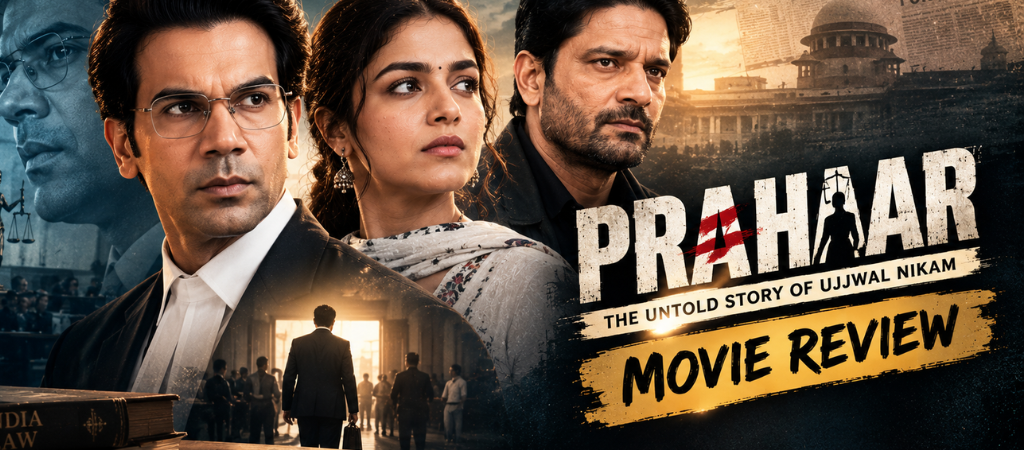
Prahaar: The Untold Story of Ujjwal Nikam is a Hindi courtroom drama based on the professional journey of Ujjwal Nikam, the well-known Indian public prosecutor associated with several high-profile criminal cases, including the 26/11 Mumbai terror attacks case. Starring Rajkummar Rao in the lead role, the film brings a real-life legal figure to the big screen and explores the challenges of pursuing justice in a case that captured the attention of the entire country.
The film combines courtroom proceedings, personal struggles and the emotional weight of a significant chapter in India’s recent history. Instead of focusing only on the legal arguments, it attempts to show the human effort behind a difficult prosecution. Rajkummar Rao leads the story, supported by Wamiqa Gabbi, Jaideep Ahlawat and other performers.
One of the film’s biggest strengths is its subject. A story involving the pursuit of justice after a national tragedy naturally carries considerable emotional and historical importance. The courtroom setting also creates opportunities for tense exchanges, difficult decisions and moments of high drama.
However, an important real-life subject does not automatically guarantee a perfect film. The screenplay must also develop its characters, maintain a strong pace and provide enough insight into the central figure. These are important points to consider when evaluating Prahaar.
In this Prahaar: The Untold Story of Ujjwal Nikam Movie Review, we look at the film’s story, performances, direction, courtroom drama, strengths and weaknesses to help readers understand what they can expect.
Prahaar Movie Details
Here is a quick overview of the film.
| Movie Information | Details |
| Movie Title | Prahaar: The Untold Story of Ujjwal Nikam |
| Release Year | 2026 |
| Language | Hindi |
| Genre | Biographical drama, courtroom drama |
| Lead Actor | Rajkummar Rao |
| Lead Cast | Rajkummar Rao, Wamiqa Gabbi, Jaideep Ahlawat |
| Other Cast Members | Lalit Prabhakar and other supporting performers |
| Director | Avinash Arun |
| Central Figure | Ujjwal Nikam |
| Main Subject | Legal prosecution and the pursuit of justice |
| Release Date | October 16, 2026 |
The film draws on a real legal career and a significant historical case. Its challenge is to balance factual events with cinematic storytelling while giving viewers a meaningful understanding of the people involved.
Prahaar Movie Story: What Is the Film About?
The story of Prahaar centres on Ujjwal Nikam and the demanding work involved in prosecuting serious criminal cases. Nikam became widely known for his role in high-profile cases, particularly the prosecution following the November 2008 terrorist attacks in Mumbai.
Those attacks caused immense loss of life and left a lasting impact on the country. The subsequent legal proceedings required investigators, prosecutors and other officials to establish the facts, present evidence and pursue accountability through the judicial system.
The film uses this background to explore the pressure associated with a case of enormous public importance. A courtroom drama based on these events has several layers: the search for evidence, the presentation of arguments, the challenges faced by the prosecution and the expectations of a society seeking justice.
A Story About the Pursuit of Justice
One of the central themes of the film is the effort required to pursue justice after a devastating event.
Legal proceedings are not always as simple as they appear in headlines. Prosecutors must work with evidence, examine the details of a case and present arguments within the rules of the judicial system. They must also respond to challenges that can affect the progress of a trial.
This makes Nikam’s professional journey an interesting subject for a feature film. His work offers a way to explore how legal professionals approach difficult cases and the responsibility associated with representing the prosecution.
The Human Side of a Legal Battle
Another important aspect of a biographical courtroom drama is the person behind the professional role.
A prosecutor may appear confident and determined in court, but the work behind that public image can involve pressure, preparation and difficult choices. Exploring these aspects can help viewers understand the personal demands of a demanding career.
For Prahaar, the opportunity lies in showing how professional responsibilities and personal life can influence one another. A deeper examination of Nikam’s motivations, challenges and decisions could make the character more relatable.
The film’s overall impact depends on how effectively it balances these personal elements with the wider historical events.
Prahaar: The Untold Story of Ujjwal Nikam Movie Review: What Works Well?
1. Rajkummar Rao’s Performance
Rajkummar Rao is one of the main reasons audiences may be interested in Prahaar. Known for taking on a variety of dramatic roles, he brings considerable acting experience to a character based on a real person.
Playing a public prosecutor requires more than delivering courtroom dialogues. The actor must communicate confidence, concentration and the ability to respond under pressure. Small changes in expression, body language and dialogue delivery can help make a legal character believable.
The role also demands a balance between professional authority and human emotion. If the character appears too forceful throughout the film, he may feel one-dimensional. Showing moments of doubt, frustration or reflection can create a more complete portrait.
Rao’s casting gives the film a strong central performer. The effectiveness of the portrayal ultimately depends on how well the writing and performance work together to present Nikam as a real person rather than simply a symbol of justice.
2. A Subject With Historical Importance
The film’s subject gives it significance beyond ordinary courtroom entertainment.
The 26/11 Mumbai attacks remain an important and painful event in India’s modern history. A story connected to the subsequent legal proceedings can help audiences understand that justice involves detailed work long after the immediate tragedy has ended.
A courtroom drama can also introduce viewers to the importance of evidence, legal procedure and the responsibility of the prosecution. These elements provide substance to the story and create opportunities for thoughtful storytelling.
The subject is particularly valuable when the film explains the legal process clearly without oversimplifying it.
3. The Courtroom Drama
Courtroom scenes can be among the most engaging parts of a legal film. They create conflict through arguments, evidence, questioning and the pressure of making a convincing case.
In a story like Prahaar, these scenes can communicate the difficulty of presenting a complex case before a court. They can also show how preparation and attention to detail matter when the stakes are high.
However, strong courtroom drama requires more than loud speeches or dramatic pauses. The arguments need to make sense, the stakes should be understandable, and the opposing positions should feel credible.
When these elements come together, courtroom sequences can maintain tension even when the action takes place largely through dialogue.
4. The Supporting Cast
A biographical drama needs more than a compelling lead character. The supporting cast helps create the professional and personal environment surrounding the central figure.
Wamiqa Gabbi, Jaideep Ahlawat and Lalit Prabhakar add further acting talent to the film’s ensemble. Their contributions can help broaden the story beyond the lead character, depending on the depth of their roles.
Supporting characters are particularly important in courtroom dramas because legal proceedings involve several people with different responsibilities and perspectives.
The screenplay needs to give these characters enough purpose so that they feel connected to the central story rather than appearing only to move the plot forward.
5. The Direction
Avinash Arun directs Prahaar. A film based on a real legal case requires careful decisions about tone, historical context and dramatic pacing.
The director must decide how to move between courtroom proceedings, personal moments and the wider background of the case. Too much focus on legal details can make the film feel dry, while too much emotional drama can weaken the sense of realism.
A restrained approach can be effective for a story involving a real tragedy. The events themselves carry considerable weight, so the filmmaking does not need to exaggerate every moment to create an emotional response.
The strongest direction for such a film allows the characters, evidence and consequences to drive the drama.
What Doesn’t Work as Well in Prahaar?
A balanced review should also consider the areas where the film may leave viewers wanting more.
1. Limited Exploration of the Main Character
One possible weakness is the depth given to Ujjwal Nikam’s personal and professional journey.
When a film is based on a real person, audiences often expect to understand more than the person’s most famous cases. They may want to know what shaped the individual’s approach to work, what challenges they faced and how their experiences influenced their decisions.
If the story spends most of its time revisiting familiar events, the central character can become less interesting than the historical case itself.
A more detailed exploration of Nikam’s motivations and professional development could give the story greater emotional depth.
2. A Familiar Narrative Structure
Real-life courtroom stories often follow a recognisable pattern: an important case begins, the prosecution faces obstacles, evidence is presented, and the legal process moves towards a conclusion.
This structure is not necessarily a problem. Familiar storytelling can help viewers follow a complicated case. However, the film still needs fresh insights and strong character development to distinguish itself from other legal dramas.
The most effective biographical films find a way to make the audience understand familiar events from a meaningful new perspective.
3. Balancing Legal Details and Personal Drama
A film about a prosecutor has to balance two major elements: the legal case and the person’s life outside the courtroom.
If the film focuses too heavily on legal proceedings, viewers may understand the case but feel disconnected from the central character. If it spends too much time on personal drama, the legal story may lose momentum.
This balance is especially important when the subject is based on real events. The audience needs enough context to understand the legal stakes without feeling overwhelmed by information.
4. The Need for Deeper Character Development
Strong performances can make characters memorable, but the screenplay must provide enough material for actors to develop them.
Viewers need to understand what motivates the main character, how the events affect him and whether his experiences change his perspective. Without these details, even a well-acted role can feel incomplete.
More attention to the emotional and professional challenges of the central figure could make Prahaar more engaging for viewers who want a deeper biographical portrait.
Prahaar Movie Performances: How Does the Cast Contribute?
The performances are an important part of a film whose drama depends heavily on dialogue, reactions and character interactions.
Rajkummar Rao
Rao carries the central role and provides the film with its main point of focus. His performance needs to balance the authority of an experienced prosecutor with the complexity of a person working under significant pressure.
For viewers, the key question is whether the character feels like a complete human being rather than only a courtroom figure.
Wamiqa Gabbi
Wamiqa Gabbi adds another important presence to the cast. The value of her role depends on how much the screenplay allows her character to contribute to the story and its emotional development.
In a film centred on a prominent public figure, meaningful supporting roles can help provide perspective and prevent the narrative from becoming too narrowly focused.
Jaideep Ahlawat
Jaideep Ahlawat is known for his work in intense dramatic roles. His presence adds another experienced performer to the cast.
In a courtroom drama, characters need to feel convincing even when their views or interests conflict. Strong supporting performances can help create the tension necessary to keep the legal proceedings engaging.
Lalit Prabhakar and Other Supporting Performers
The supporting cast helps establish the world in which the main character operates. Their performances are most effective when their characters have clear motivations and a meaningful relationship with the central conflict.
Overall, the ensemble provides the film with a strong acting foundation, while the depth of the screenplay determines how fully each performer can contribute.
Prahaar Movie Strengths and Weaknesses
Here is a quick summary of the film’s main talking points.
| Strengths | Areas That May Disappoint |
| Rajkummar Rao in the central role | The protagonist’s personal journey may need more depth |
| A historically important subject | Some events may feel familiar to viewers |
| Scope for tense courtroom sequences | Legal and personal elements may not always feel balanced |
| An experienced supporting cast | Supporting characters need sufficient development |
| A story about justice and accountability | The screenplay must avoid becoming overly procedural |
This comparison helps explain why a film can be compelling in its performances and subject matter while still having room for improvement in its storytelling.
Is Prahaar Worth Watching?
Prahaar: The Untold Story of Ujjwal Nikam may interest viewers who enjoy courtroom dramas, biographical films and stories connected to significant historical events.
It is especially relevant for audiences who want to understand more about the legal process that followed the 26/11 Mumbai attacks. The subject provides a serious foundation, while Rajkummar Rao’s central role gives viewers a familiar performer to follow.
You may find the film interesting if you enjoy:
- Courtroom arguments and legal dramas.
- Biographical films about real people.
- Stories about justice and accountability.
- Performances that rely on dialogue and character development.
- Hindi films inspired by significant historical events.
On the other hand, viewers looking for a fast-paced thriller with frequent action may have different expectations. A film focused on legal proceedings often relies on conversations, evidence and gradual developments rather than continuous physical action.
Ultimately, whether the film is worth watching depends on how much you value its subject, performances and approach to storytelling.
Prahaar Movie Rating and Final Verdict
A movie rating should reflect the overall viewing experience rather than the importance of the real-life subject alone. Acting, direction, screenplay, pacing, character development and emotional impact all contribute to a fair assessment.
For Prahaar, Rajkummar Rao’s central performance and the importance of the story provide strong reasons for interest. The courtroom setting also offers opportunities for tense and thoughtful drama.
The main challenge is giving the audience a sufficiently detailed picture of Ujjwal Nikam beyond the major events associated with his career. A deeper exploration of his personal motivations and professional challenges could make the film more memorable.
Final verdict: Prahaar: The Untold Story of Ujjwal Nikam is a courtroom drama built around an important real-life subject. Its appeal lies in the central performance, the legal proceedings and the questions surrounding justice after a national tragedy. Viewers who enjoy serious biographical dramas may find it worth considering, although the depth of the screenplay and character development will determine how strongly the film ultimately connects with them.
Rather than assigning an unsupported numerical score, this review focuses on the elements viewers should consider when deciding whether the film matches their interests.
Frequently Asked Questions (FAQs)
1. What is Prahaar: The Untold Story of Ujjwal Nikam about?
The film follows the professional journey of Ujjwal Nikam, a public prosecutor associated with several high-profile cases, including the prosecution following the 26/11 Mumbai attacks. It explores the legal challenges and pursuit of justice connected to this work.
2. Who plays Ujjwal Nikam in Prahaar?
Rajkummar Rao plays the central role of Ujjwal Nikam. His performance is a major focus of the film.
3. Who directed Prahaar: The Untold Story of Ujjwal Nikam?
The film is directed by Avinash Arun.
Also Check: Udta Teer Movie Review: Story, Trailer, and Expectations
Conclusion
Prahaar: The Untold Story of Ujjwal Nikam brings a significant legal story to the screen through the life and work of a prominent public prosecutor. With Rajkummar Rao in the lead role and Avinash Arun directing, the film has a strong foundation for a serious courtroom drama.
Its historical subject gives the story weight, while the courtroom setting offers opportunities to explore evidence, responsibility and the difficult process of pursuing justice. The performances and the screenplay’s treatment of the central character are important factors in determining the film’s overall impact.
For viewers who enjoy biographical dramas and legal stories, Prahaar is a film worth considering. Its ultimate success as a movie depends not only on the importance of the events it portrays but also on how effectively it develops its characters and turns a complex real-life story into compelling cinema.